I’ve been running Xponent since 2003. We’ve watched a lot of technology waves wash through, including the move to cloud, the rise of mobile, the SaaS boom, the analytics era. Most of them changed how work got done without fundamentally changing which humans you needed to do it.
This one’s different.
Over the last two years, I’ve watched AI quietly eat large portions of what marketing teams used to do. Not the headline-making parts, such as ‘AI will replace creativity’ or ‘prompt engineers will take over,’ but the boring parts. The draft-this-email part. The pull-this-report part. The write-fifteen-ad-variants part. The summarize-customer-feedback part. The first-draft-of-the-blog-post part.
And the more I’ve looked at what’s left, such as what humans still need to do or what AI still can’t do well, the more obvious it’s become that marketing jobs aren’t being destroyed.
I’m writing this the same week we’re rebuilding our own growth team from scratch around this reality. What follows is what I’ve come to believe about where each role is heading. If you work in digital marketing and you’ve been feeling the ground shift, this is for you.
The core observation
Every marketing role has two layers: an execution layer and a judgment layer.
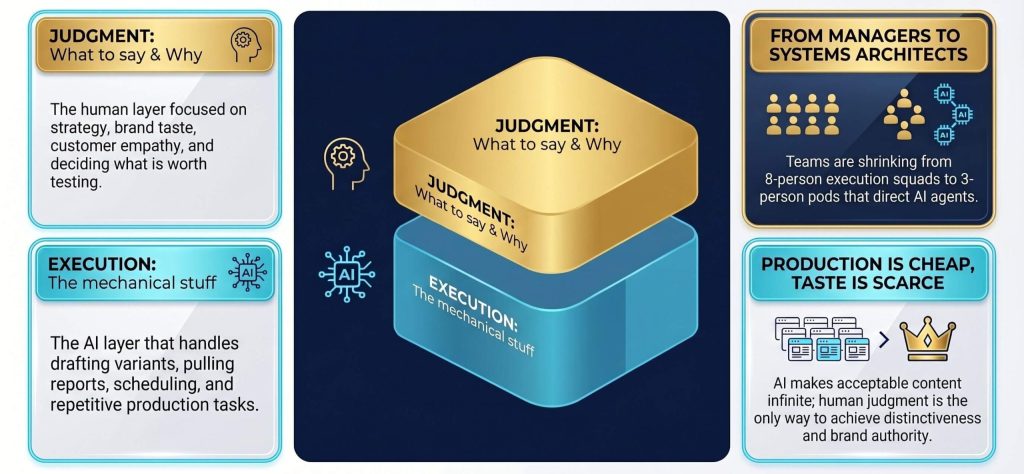
The execution layer is the mechanical stuff. Writing ad copy. Producing variants. Drafting emails. Scheduling posts. Pulling reports. First-pass customer support. Topic research. Competitor monitoring. A/B test setup.
The judgment layer is the decisions. What to say. Who to say it to. Why we’re saying it at all. What’s worth testing. What the data actually means. When to kill something. What makes our brand feel like ours. Whether this customer needs empathy or a refund.
For most of marketing’s history, these two layers were bundled into single roles. A content marketer did both the judgment (what should we write about, for whom, why) and the execution (actually writing it, editing it, publishing it, distributing it). A performance marketer did both the strategy (which channels, what to test, how to read results) and the execution (writing ad copy, launching campaigns, pulling reports).
AI has cleanly separated these layers. The execution layer is now mostly doable by a well-prompted AI agent. The judgment layer is not.
That’s the whole thing. Every shift in marketing roles right now flows from that one decoupling.
What’s actually changed
Let me be concrete. Here’s what’s now mostly AI-operable, or will be within the next 12 months:
- Writing first drafts of ads, emails, and blog posts
- Producing creative variants at scale (for ads, landing pages, email subject lines)
- Keyword research and competitive SEO analysis
- Reporting and basic data summaries
- First-level support and triage
- Help documentation and FAQ maintenance
- Lead enrichment and personalization of outbound
- Social post scheduling and variant creation
- Content repurposing across formats
- Media buying (algorithmic bidding has already eaten most of this)
And here’s what remains stubbornly human:
- Knowing what your product actually is, who it’s for, and why it wins
- Spending time with customers and forming a real point of view about their lives
- Designing experiments that test the right things
- Reading messy data honestly and making calls under uncertainty
- Holding a consistent brand voice that doesn’t drift into genericness
- Taste — the ability to look at AI output and reject what’s bad
- Judgment about when to ship, when to kill, when to pivot
- Relationship work — partnerships, community, anything involving trust
The people who will do well in marketing over the next decade are the ones who move their time from the first list to the second.
The new team shape
This has consequences for how teams should be built.
The old marketing org chart assumed that execution was labor-intensive and specialized. You needed a copywriter because writing took time. You needed an SEO specialist because keyword research took time. You needed a performance marketer because campaign management took time. You needed a graphic designer because making 30 ad variants took time.
Take away most of that time, and the math changes. A team of eight people, each doing 80% execution and 20% judgment, can be replaced by a team of three people, each doing 80% judgment and 20% direction of AI systems that handle the execution. The output can actually be higher, not lower.
What you need instead is a small pod of humans who:
- Set strategy and make judgment calls
- Talk to customers and bring the team insight
- Hold taste and brand voice
- Design experiments and read results
- Direct and supervise a stack of AI agents doing the execution underneath them
This is not theoretical for us. It’s how we’re designing the growth team at the online/SaaS side of our business right now. Lean human team, aggressive AI leverage, each human owning outcomes rather than activities.
The seven roles, reimagined
Here’s how I see each major role on a modern growth team shifting. Over the coming weeks, I’ll publish a deeper piece on each one.
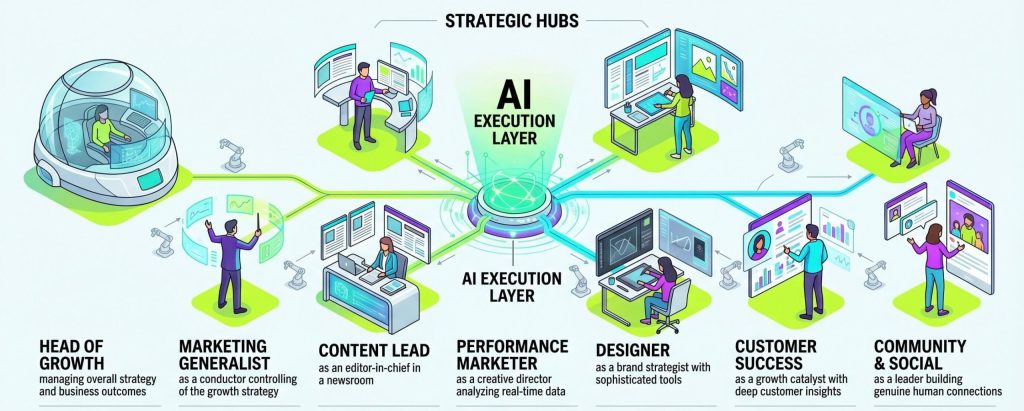
These cover what’s changing, what’s dying, what’s becoming more valuable, and what a digital marketer today should do if they want to become the new version of this role rather than be replaced by it.
1. Head of Growth: Used to be a funnel manager overseeing specialists. Now it’s closer to a systems architect. This is someone who designs the whole growth machine (humans, agents, channels, data) and is accountable for business outcomes, not marketing activities. The most senior role has become more strategic, not less.
2. Marketing Generalist: The once-awkward “jack of all trades” is suddenly the most valuable seat on the team. When AI handles the execution layer, the person who can orchestrate across everything and who knows a little about a lot is irreplaceable. Specialization without breadth is a liability now.
3. Content Lead: The “write ten blog posts a month” model is dead. What’s replaced it is editorial direction. This involves deciding what to write, why, for whom, and making sure AI-produced content doesn’t sound like everyone else’s AI-produced content. The role is more like running a publication than running a content calendar.
4. Performance Marketer: Meta and Google now run the bids. Creative testing is where the work lives. It involves deciding what to test, judging what’s good, and reading incrementality honestly. The “campaign manager” version of this role is fading fast. The “creative + analytics strategist” version is becoming one of the most leveraged seats in marketing.
5. Designer: AI can make an image in three seconds. It still can’t build a brand. The designer’s job is becoming more about systems, taste, and direction, while becoming less about production. The people who use AI tools aggressively and maintain strong taste are going to command a premium.
6. Customer Success / Activation: AI-first support is finally freeing CS from the grind of reactive tickets. What takes its place is the strategic part of the role: driving activation, reducing churn, being the voice of the customer inside the company. This is genuinely good news for anyone in support who felt stuck.
7. Community & Social: “Post ten times a week” is now a solved problem for AI. What AI cannot do is build an audience, hold a distinctive voice, or know which comment to reply to and how. Community building, in its real version, has never been more valuable. Social content production has never been less valuable.
What this means if you’re a digital marketer
I’ve hired and talked to a lot of marketers over the last few years. The ones I’m most bullish on right now aren’t the ones with the longest CVs. They’re the ones who’ve already started adapting. These individuals have rebuilt their workflow around AI tools, can show you what they’ve automated, and have opinions about what’s changing and what to do about it.
The ones I’m least bullish on are the ones who treat AI as optional, or as “a tool for writing captions faster,” or as something that will only affect people less senior than them. This is exactly backwards. Senior people who don’t adapt will be competing with junior people who have.
The good news: the shift is surprisingly accessible. Nobody has more than a couple of years of experience doing this well. The learning curve is steep but short. A mid-career marketer who commits to rebuilding their workflow around AI over the next six months can come out of it more valuable than they’ve ever been.
The bad news: there’s no neutral option. “Wait and see” is a choice, and it’s the wrong one.
What we’re doing about it
At Xponent, we’ve been building SaaS products alongside our services business for years, and we’re now building a dedicated growth team for the online/SaaS side. This team is specifically designed around the human + AI pod model I described above.
If you’ve been feeling the shift and you want to be part of building what the new version of marketing looks like, we’re hiring across the whole team. Details are on our careers page.
If you’re a marketer somewhere else, going through your own version of this transition, I hope this series is useful. The individual role pieces will get specific about what to learn, what to build, and what to show to become the new version of your role. They’re coming over the next few weeks.
More to come.