Every time I’ve written about AI and jobs, Customer Success people have been the most anxious audience. That anxiety is understandable. A lot of public commentary about AI in CS sounds like “chatbots are coming for your job.” At the surface level, it looks like the most directly automatable function on a go-to-market team.
I want to make an argument that I think will feel counterintuitive at first: AI-first support is the best thing that’s happened to Customer Success careers in at least a decade. Not in spite of the automation, but because of it.
To explain why, I need to start with an honest observation about how the CS role actually worked and how it got stuck.
The CS role was quietly broken for a long time
For most of the SaaS era, Customer Success sat in a weird career position. Not quite support. Not quite sales. Not quite product. The role bundled together a grab-bag of responsibilities: onboard new customers, answer questions, chase renewals, track health scores, run QBRs, flag churn risks, write help docs, escalate bugs, manage expansion conversations where applicable.
In theory, the role was strategic. The name of the department literally included “success.”
In practice, most Customer Success people I have talked to spent 60–80% of their week on reactive work. This includes tickets, escalations, and the same onboarding conversations over and over. The strategic part of the job includes understanding why customers churn, running activation experiments, and driving product feedback. This work was often crammed into whatever time was left, which was usually not enough.
The measurement system reinforced the trap. Most CS teams were measured on response times, ticket volume, CSAT scores, and retention rates. None of those metrics rewarded the strategic work. They rewarded the reactive work. So the reactive work ate everything.
Compensation reflected it. CS roles were consistently paid less than sales roles doing comparable work in terms of revenue impact because CS was coded as a cost center while sales was coded as revenue generation. This was always a distortion. In most SaaS businesses, retention drives more revenue than acquisition, but it was the distortion we all lived with.
This is the context you need to read the AI shift into. CS wasn’t a role working well that’s now being threatened. CS was a role stuck in a reactive ceiling, and AI is what’s finally breaking the ceiling.
What AI actually changed
The operational shift is pretty concrete.
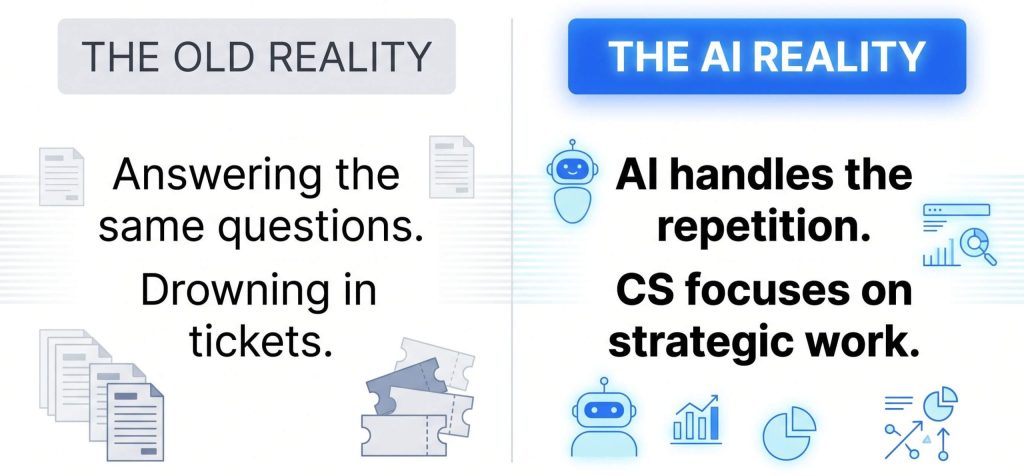
AI now handles a significant portion of Tier 1 support. It manages frequently asked questions, simple troubleshooting, and password reset tickets that used to consume CS hours. Properly set up, AI resolves 30–60% of inbound tickets entirely, depending on the product and the configuration. For the tickets that do reach a human, AI drafts responses, pulls up context, and suggests next steps. The human still handles the case, but the time per ticket drops.
Every CS team knows that help documentation should be better but never has the time to make it so. Now, this documentation can be drafted, updated, and maintained at a scale that was not possible before. Onboarding sequences can be personalized based on user behavior without someone manually writing hundreds of variant emails. Customer health signals can be synthesized from product usage, support sentiment, and behavior patterns in ways that used to require a dedicated analyst.
Here’s what all of this adds up to: the reactive ceiling on the role is gone. The hours that used to get spent answering the same question for the five hundredth time can now get spent on the strategic work that was always supposed to be the core of Customer Success but never actually fit into the week.
That’s the opportunity. And it’s bigger than most people in the role have yet realized.
What’s dying
The parts of the old CS role that are visibly fading:
1. Ticket-closer mentality.
“I answered 200 tickets this week” was never a career story. It’s increasingly not even a job. The CS people who still define their work by ticket volume are describing the part of the role AI is taking over.
2. Pure reactive support as a long-term career.
Reactive support is becoming either AI-handled or compressed into a smaller team. You can still make a career in it, but the ceiling is lower than it used to be, and the growth path is flatter.
3. Response-time as a primary metric.
Faster is good; fastest is not the goal. Measuring CS by how quickly tickets get closed is the wrong game when AI can close many of them instantly. The metrics that survive are the ones tied directly to customer outcomes. These include activation, retention, expansion, and a serious approach to NPS.
4. The “support is a cost center” framing.
This was always wrong, but AI is what’s going to finally kill it. When AI handles the cost-center work, what’s left is the strategic work, and the strategic work is straightforwardly a revenue function.
5. CS as a career cul-de-sac.
The old pattern was to start in support, move to CS, and perhaps become a CS manager or pivot to sales. That path still exists, but new paths are opening. These include transitions from CS into product, marketing, and growth. CS is becoming one of the best early-career seats for anyone who wants to end up in a senior operator role.
What’s becoming more valuable
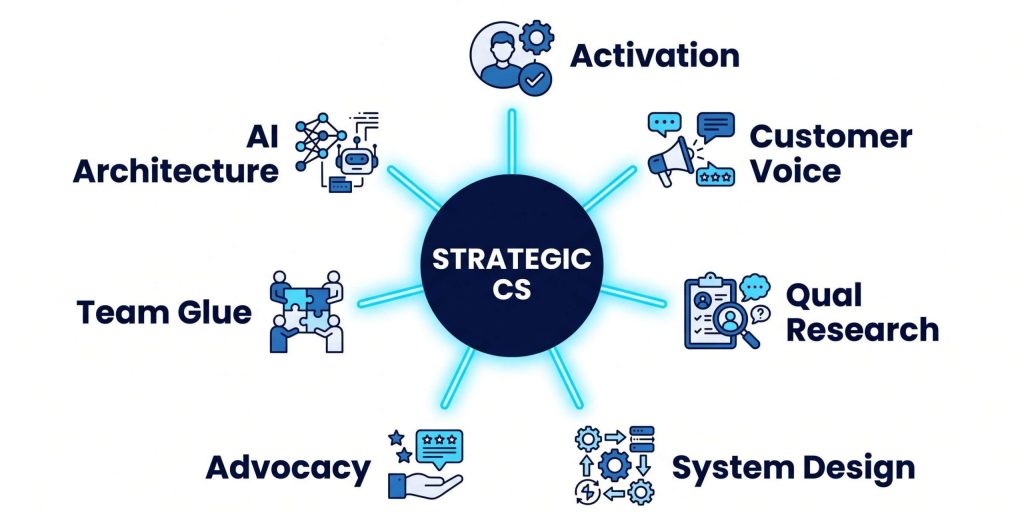
The parts of the role that have grown enormously in value:
1. Activation thinking.
Not just “retain the customer” but “get them to real value as fast as possible.” This is the single highest-leverage thing a CS team can own, and it used to get shortchanged because reactive work ate the week. When AI handles the reactive work, activation becomes the strategic core of the job. The CS person who can design, run, and iterate on activation programs is doing work that directly moves the business.
2. Voice of the customer, in a real way.
Most companies have a “voice of the customer” function in name only. Typically, this means someone sends around NPS summaries once a quarter. The CS person who performs this function authentically by spending hours in customer conversations and synthesizing patterns becomes one of the most valuable people on the team. Everyone else is smarter because they exist.
3. Qualitative research.
Companies have historically under-invested in qualitative user research because it was expensive and slow. The CS person who can run user interviews and turn them into insights is doing research work that once required a separate function. AI helps here with transcription, summarization, and pattern detection. However, the skill of asking good questions and hearing what is between the lines remains uniquely human.
4. Playbook and system design.
Onboarding flows. Activation sequences. In-product nudges. Help content architecture. The CS function is becoming a designer of systems that shape the user experience at scale, not just a responder to individual tickets.
5. Expansion and advocacy.
When the reactive work is handled, Customer Success can finally focus on the proactive side. This includes identifying expansion opportunities, turning power users into advocates, and surfacing case study candidates. This work has always existed in theory, but it is now becoming the core of the role in practice.
6. Cross-functional glue.
The CS person talks to more customers than anyone else in the company. That makes them uniquely positioned to sit between product, marketing, and sales. They help determine what to build, how to position the product, and how to pitch it. The CS person who plays this cross-functional role actively rather than passively is doing work that is both strategic and highly visible.
7. AI-first support architecture.
Building the AI layer that handles reactive support well. Which tool, which setup, which knowledge base, which escalation logic, which quality checks. This is a new skill and a valuable one, because most companies are currently doing it badly.
How to become this
If you’re in CS, support, or an adjacent role, here’s what I’d focus on.
1. Move out of reactive mode, deliberately.
Every week, identify a chunk of reactive work that could be AI-handled, automated, or eliminated. Build that into your role. Then use the freed time for strategic work. This include activation experiments, user research, content, and systems. If your manager pushes back, show them the retention or activation numbers that improved as a result. Move to proactive by force if necessary.
2. Get fluent in product analytics.
Master Mixpanel, Amplitude, Heap, or whatever your company uses. You do not need to be an expert. Instead, aim for a level where you can pull your own data, answer your own questions, and identify your own patterns. The CS person who can analyze behavior is in a completely different league from the one who waits for analytics to send them a dashboard.
3. Learn to set up AI-first support.
Intercom Fin, Zendesk AI, Claude or GPT-based custom setups, knowledge bases optimized for retrieval. Build the stack that handles your Tier 1 well. This is table stakes now, and most companies are still early. Being the person who knows how to do this well makes you the person who runs the function.
4. Develop real writing skill.
Help docs, in-product copy, onboarding emails, and customer communications make up a significant portion of CS production. AI is a tool that amplifies good writing into great writing. However, it cannot replace the underlying ability to think clearly in prose. Invest in writing as a skill.
5. Run user research actively.
Don’t wait for permission. Book interviews. Send surveys. Read tickets for patterns. Write up synthesis documents and share them across the company. Being the person who brings customer insight to the team is one of the highest-leverage moves in any company.
6. Connect your work to revenue.
Learn to talk about your work in business terms. This includes metrics such as activation rate, retention curves, expansion revenue, and CAC payback. CS people who can hold this conversation with the founder or the finance team stop being seen as “support people” and start being seen as operators. This is the same work with different framing, leading to a very different career trajectory.
7. Partner with product and marketing, visibly.
Send customer insights to product. Flag messaging issues to marketing. Identify expansion opportunities for sales. Make yourself the person who creates value across functions, and you’ll never be stuck in a reactive seat again.
Signals you’re ready
Markers I use when evaluating Customer Success candidates for modern, strategic roles:
- Can you show me an AI-first support setup you’ve built or heavily influenced?
- Do you know your product’s activation rate and what drives it?
- Can you name three specific patterns you’ve identified from customer conversations this quarter?
- Have you turned customer feedback into a product change or marketing change?
- Can you talk about retention at a cohort level, not just an aggregate level?
- Do you write well — in help docs, emails, or in-product copy?
- Can you hold a conversation about unit economics and why your work matters to the business?
If most of those are yes, you’re in the top tier of CS candidates right now, and you should be pushing for roles and comp that reflect it. If most of them are no, that’s the development path.
The career arbitrage
Here is the thing I want Customer Success people to really internalize about this moment. Historically, the role was undervalued. It was underpaid, underrecognized, and stuck in a reactive ceiling. AI is now forcing a reset. The reactive work becomes cheap, while the strategic work becomes essential. Companies that figure this out will pay more for CS than they used to because the job they are paying for is genuinely more strategic.
But that reset is happening unevenly. Some companies will figure it out fast; others will spend years still measuring CS by response times and treating the function as a cost center. The CS people who understand the shift early, build the strategic skills, and can articulate their impact in business terms will have their pick of roles. The ones who keep operating in reactive mode will watch the ceiling close in.
This is the best kind of career arbitrage: a widely undervalued function being forced into a rerating. If you’re in CS right now, pay attention. The next two or three years are when the asymmetry is largest.