If you run social accounts, you know the job has been quietly absurd for a while. You are asked to produce constant content across multiple platforms and various formats. You must maintain a platform-specific voice under strict brand guidelines at an unsustainable volume. No human can generate this while also engaging authentically with hundreds of comments. The role assumed a production capacity that no human actually possesses. It then measured success by numbers that had nothing to do with business outcomes.
AI has done the same thing to this role as content and support. It has effectively collapsed the production part of the work to near-zero. Anyone can now generate a month of decent social content in one afternoon. Anyone can produce platform-native variants or manage the entire scheduling stack.
Which would be bad news, except for one thing: nobody scrolls social media looking for decent content. People scroll through feeds looking for a voice or presence that makes them stop. AI has made decent content infinite, but true quality remains very hard to find. What is rare now is content that actually registers as worth your attention. This gap is exactly where the modern version of this role now lives. This new path is much more interesting than the one it is replacing.
The old social media manager’s job
For most of the 2010s and into the early 2020s, being a social media manager meant a specific operational load.
You owned a calendar. You wrote captions. You produced or coordinated graphics. You scheduled posts across Facebook, Instagram, LinkedIn, Twitter/X, sometimes TikTok, sometimes YouTube. You engaged with comments and DMs. You did hashtag research. You tried to keep up with algorithm changes on each platform. You reported on reach, engagement, follower growth, sometimes clicks. You probably spent too much time in meetings defending why those metrics had moved.
Community management was a related role involving Facebook groups, Discord servers, and Slack communities. This work often had a more human-relationship texture than standard social media management. However, it shared the same fundamental shape as other production-heavy roles. It required a lot of production work and a high volume of reactive engagement. Companies measured success by activity metrics and generally treated it as a junior function. This happened regardless of how much actual judgment the role required from the operator.
The role attracted two different kinds of people who approached the work uniquely. The first group genuinely loved platform culture and understood why specific trends went viral. They had audience intuitions that could not be formalized into a standard process. The second group fell into it because they were young and understood social media. Both groups received the same job title and usually earned very similar pay. This was one way the role was historically misaligned with actual skill requirements.
What AI actually changed
The operational bottom of the role has fallen out.
Captions are now drafted in seconds while variants across platforms are fully automated. Graphics and visual content are generated on demand to meet any creative requirement. Scheduling is not just automated but is now AI-optimized for the best possible timing. Hashtag research is mostly obsolete because the algorithms handle it much more effectively. Content repurposing from long-form to short is a solved problem with modern tools. Even engagement on common comments can be drafted or handled by sophisticated AI models.
The entire production layer of social media has vanished as a primary job function. This specific part used to consume seventy percent of a manager’s weekly workload. A well-prompted AI setup can produce a month of native content in one afternoon. Most of that content will be competently written and visually passable for the brand. However, it will also be completely interchangeable with what every other company produces. Similar AI setups across different brands are now creating a sea of identical content.
This is the critical thing: the flood has already started. Every feed is now awash in AI-generated content, AI-drafted captions, AI-produced graphics. The ambient quality of “decent” social content has risen while the ambient memorability of it has fallen to approximately zero. Every brand post blurs into every other brand post.
AI cannot produce a distinctive voice or a specific point of view on its own. Only real relationships and genuine community can break through the flood of digital content. Real presence is now the most valuable asset any modern brand can actually possess. The role has shifted from generating volume to the more difficult challenge of capturing attention. This new focus represents a much more specific and harder problem for the industry.
What’s dying
The parts of the old role that are visibly fading:
1. “Post X times a week” as a job.
If your job description is measured in volume of output, you’re describing the part of the role AI is absorbing. Volume was never the point, but the industry measured it because it was measurable. That era is ending.
2. Follower count as the metric.
The number of followers has always been a vanity metric. It’s becoming an actively misleading one, because follower counts can be purchased, inflated, or accumulated without meaningful engagement. The signal-to-noise ratio of followers as a proxy for anything real has collapsed.
3. Generic brand voice.
Every brand that sounds like every other brand is invisible now. “Professional, friendly, approachable” is not a voice. It’s a template. Templates don’t cut through AI-flooded feeds. The brands that get engagement have a distinctive, often slightly weird voice that feels specifically like them.
4. Hashtag strategy as a discipline.
I know people still teach hashtag strategy. It’s become a minor input at best, a waste of time at worst. Platforms have moved on. Discovery is driven more by content signal and engagement velocity than by hashtag taxonomies.
5. Pure scheduler roles.
Someone whose entire contribution is writing captions and scheduling posts is in a shrinking role. This is true regardless of whether they are a full-time employee or a contractor. The primary job is not the scheduling of content for various social media platforms. It was never really about the scheduling part of the work in the first place.
6. The “young person who understands social” hiring pattern.
Relying on age for social media roles was always a lazy and unfair practice. This mindset is increasingly unproductive for companies that want to succeed in the modern market. Understanding social platforms in 2026 requires a high level of strategic thinking and analysis. Professional skills like managing voice and community are not traits tied to a specific generation.
What’s becoming more valuable
The parts of the role that have grown into the actual job:
1. Building an audience, not a following.
These are different things. An audience pays attention to you, cares about what you say, remembers you, and talks back. A following is a number. The community builder who understands this distinction is doing work that almost no AI can touch. They measure and grow an actual audience to create a much more sustainable business.
2. A distinctive voice.
When every brand sounds the same because they’re all prompting similar models, a distinctive voice becomes an asset that compounds over time. This is the single hardest thing to build and the single most valuable thing a brand can have on social.
3. Point of view.
Brands that have opinions are getting shared. They speak about their industry, their users, what good work looks like, and what they care about. Brands that post “tips and tricks” are getting scrolled past. AI is great at tips and tricks. It cannot produce a point of view on its own.
4. Real engagement.
Not “thanks for the comment!” but actually engaging with what someone said. You must show up in specific conversations and build relationships with individual humans who matter. This scales badly, which is exactly why it is valuable in the current market. Everyone else is trying to scale the unscalable with AI and they are failing visibly.
5. Community, actually.
The word “community” has been abused in marketing for a decade to describe basic audiences. These groups were really just followers rather than an actual community with shared interests. Real community is rare and valuable. It involves people who talk to each other and have their own unique social dynamics. Building one takes years and patience. The people who know how are increasingly sought-after.
6. Platform-specific depth.
General social media expertise is less useful than deep understanding of specific platforms. The community builder who really understands LinkedIn dynamics, or TikTok dynamics, or what’s actually happening on X right now, has a much rarer skill than the generalist who “runs social.” AI hasn’t made platform-specific knowledge less important; it’s made it more important, because AI’s default output is platform-agnostic.
7. Creator thinking.
The line between creator and community builder has blurred. The best community work now is done by people who think like creative content creators. These professionals are willing to be visible and to have a strong take on their industry. They build a personal presence alongside the brand presence to foster deeper trust with the audience. “Faceless brand” social is becoming a harder game to win.
8. Video and audio literacy.
Short-form video is now a major social surface, and podcasts/audio are a growing one. The community person who can think in video and audio formats (even if they don’t personally produce them) is operating at a different level than one who only thinks in text and graphics.
How to become this
If you do social or community work, here is what I would focus on now. This advice is for those working in-house, at an agency, or in a freelance capacity.
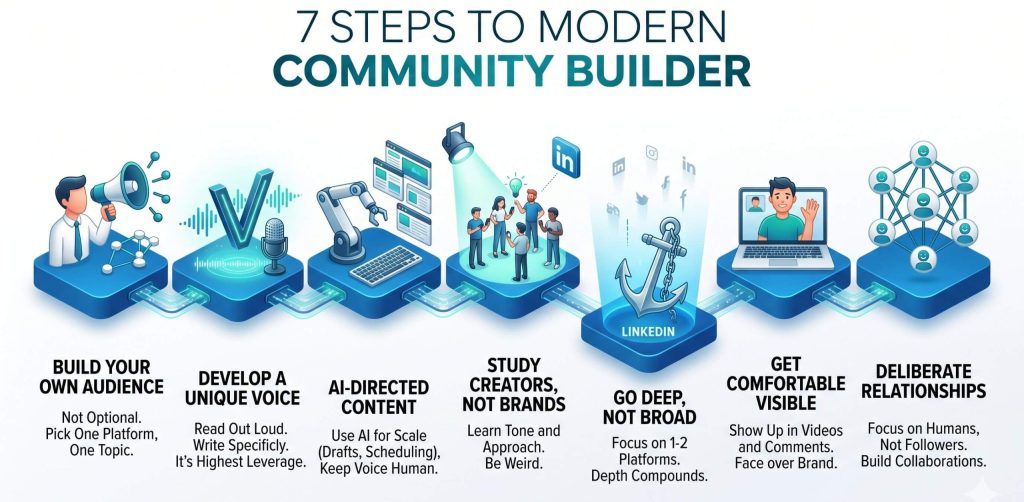
1. Build your own audience first.
Not optional. If you can’t build an audience for yourself, you can’t reliably build one for a brand. Pick a platform, pick a topic, start posting with a real voice. Do it for a year before you take it seriously. The experience of building something from zero will teach you more about community than any course or certification.
2. Develop a voice you’d actually recognize.
Read your own writing out loud. Does it sound like you or does it sound like everyone? If it sounds like everyone, that’s where the work is. Voice comes from reading a lot, writing a lot, and being specific about what you think. It’s slow. It’s also the highest-leverage thing you can build.
3. Build AI-directed content workflows.
Let AI do the production scaling for variants, repurposing, scheduling, and your first drafts. Don’t let it do the voice. Your prompt stack should be focused on scale, not originality. The originality comes from you; the scale comes from the tools.
4. Study creators, not just brands.
Most brand social is bad. Most creator social is better. Study the creators who are breaking through in your space. Notice what they do that brands don’t. Steal generously. Do not steal the specific content, but rather the approach and the tone. You should also adopt their willingness to be specific and occasionally weird.
5. Go deep on one or two platforms, not broad on all of them.
Depth compounds. Understanding LinkedIn really well will serve you for years. Spreading yourself thin across six platforms will make you a generalist at a moment when generic social is worthless.
6. Get comfortable being visible.
The community builder who stays behind the brand is increasingly at a disadvantage. The community builder who is willing to appear builds relationships that the faceless version never can. You must show up in videos, in comments, and in real human conversations. This is uncomfortable for many people. It’s also the job.
7. Build relationships deliberately.
Not follower counts but relationships. You need specific humans you know who will also know you and share your work. These are the people who you can truly collaborate with in your professional space. Community is a network of relationships rather than just a simple number in a dashboard.
Signals you’re ready
Markers I’d look for in the modern version of this role:
- Do you have your own audience — even a small one — that you’ve built with your own voice?
- Can you show me an AI-directed content workflow you use, and can you also articulate what you deliberately keep human?
- Can you describe the current dynamics of one specific platform in depth — what’s working there right now, not in general?
- Does your writing have a distinctive voice, or could it have been produced by anyone?
- Have you built real relationships with other people in your industry, not just followers?
- Are you willing to be visible as part of the brand?
- Can you talk about audience in terms of retention and depth, not just reach?
If most of those are yes, you are operating at the level this role needs now. If most are no, that is the development path for your professional career. This path is longer than the other roles in this series for a specific reason. Developing a unique voice and building a community takes years rather than just a few months.
The common thread across all seven roles
This is the eighth and last piece in the series. If you have followed along, you have seen the same argument seven different ways. This has been applied to Head of Growth, generalists, content, performance, design, and customer success. Now, we are applying these same core principles to the field of community.
The common thread is simple enough to state in one line: AI has moved the value in marketing from production to judgment. Every role in this series used to be defined by how much work you could produce. Every role is now being defined by how much judgment you can apply. The execution layer is becoming cheap and abundant. The judgment layer is becoming scarce and expensive.
What this means for anyone in marketing:
- The parts of your job you have been secretly proud of just became more valuable. This includes your thinking, your taste, your judgment, and your deep understanding of the customer. It also includes your editorial sense and the hard work you put into relationships.
- The parts of your job you have been doing as a grind are fading. You should not cling to the production work, the reactive work, or volume-based output. Moving away from these tasks will allow you to focus on more strategic human work.
- The people who rise over the next five years will be the ones who move their hours, deliberately, from the first list to the second. That move is available to anyone who commits to it, regardless of current title or years of experience.
If you’ve read through this series and found yourself nodding at some pieces and squirming at others, that’s useful information. The squirming pieces are usually pointing you at where the work is.
As I mentioned at the start, we are doing this in practice. We are building a small and sharp growth team at the online side of our business. This team is architected around humans and AI agents to maximize our collective potential. We are currently hiring across all of the roles that I discussed in this series. If you want to build the new version of marketing, our careers page has details.
More importantly, if you are doing this transition elsewhere, I hope this series was helpful. This shift is real and the opportunity it provides is also very real. Those willing to rebuild their workflow over the next two years will gain incredible leverage. This effort is worth doing regardless of whether you end up joining our own company.
Thanks for reading.