Of all the marketing roles I’m writing about in this series, the content lead is the one whose job has changed the most. It is also the one where the most people are still doing the old version of the job without quite realizing it.
I have a particular stake in this one. I’ve been around the content and SEO world for a long time. We have been running Uprankly, a link building and content service, since 2015. This means I have watched this discipline evolve from keyword-stuffed articles and bought links into the current era. Now, Google’s AI Overviews eat clicks, ChatGPT is a real traffic source, and everyone has access to models that produce a 2,000-word blog post in 40 seconds.
If you do content or SEO, you’ve probably felt two contradictory things at once over the last 18 months:
- That your job is about to be automated out of existence
- That it’s never been more important
Both are true, of a kind. The production half of the job is being commoditized to zero. The judgment half of the job is becoming more valuable than it’s ever been. If you’re a content marketer reading this and wondering whether to hang on, retrain, or reinvent yourself, this piece is for you.
The old content marketer’s job
For most of the last decade, being a content marketer or content lead meant something fairly well-defined.
You built a content calendar. You did keyword research to find topics with traffic potential and manageable competition. You wrote briefs (or full posts). You edited. You published. You did internal linking. You monitored rankings. You updated old posts. You coordinated with a designer for graphics, a developer for site changes, maybe a link builder for backlinks. You presented traffic numbers every month.
The most ambitious version of the job was a real craft. It involved running a whole editorial operation that produced organic growth for a business. People built careers on it. Companies grew on it.
The less ambitious version was a grind: crank out X posts a month, aim at X keywords, hope rankings came.
Both versions assumed the same underlying fact: producing quality content was the bottleneck. Everything about how content teams were staffed, measured, and managed flowed from that assumption.
What AI (and the new search reality) changed
Two things happened at once, and the combination is what makes this role’s shift so sharp.
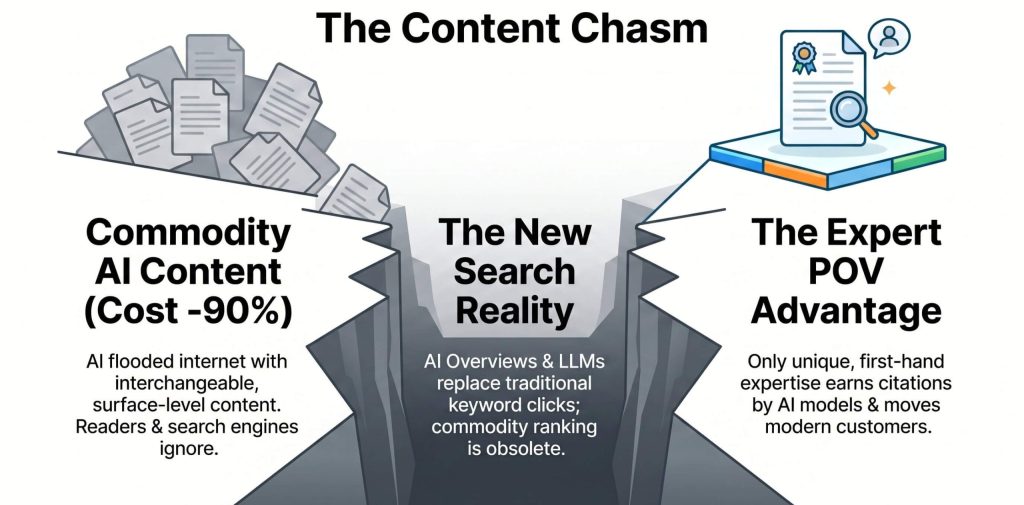
First, AI collapsed the cost of producing content. The cost of producing acceptable content fell by about 90%. While producing genuinely good content still takes real work, that cost is not falling to zero. The internet is now being flooded with AI-generated posts that are grammatically fine, surface-level coherent, and completely interchangeable. Google is drowning in this. Readers can smell it.
Second, search itself changed shape. Google’s AI Overviews are now eating a growing share of informational queries. Users get their answer on the SERP and never click through. ChatGPT, Perplexity, Claude, and Gemini are now real traffic sources for some businesses, and for others they’re starting to replace certain kinds of search entirely. Traditional “rank for a keyword, get a click” is still meaningful, but it is a shrinking slice of the discovery pie.
Together, these two shifts have reset what content work is even for.
Commodity content doesn’t rank anymore, doesn’t get cited by LLMs, doesn’t earn links, and doesn’t move customers. The internet’s floor for what counts as valuable content has risen sharply. At the same time, the ceiling is higher than ever. This is defined by what genuinely expert, point-of-view, first-hand content can do for a business. The gap between commodity content and real content has become a chasm, and the content lead’s job is now almost entirely about staying on the right side of that chasm.
What’s dying
Some of this is uncomfortable to say out loud, but the field needs the honesty.
“Write 20 posts a month” is no longer a real strategy. “Write 20 posts a month” is no longer a real strategy. If anything, producing more commodity content actively hurts a site now. It dilutes authority, confuses Google about what your site is about, and correlates with the kind of thin content that quality algorithms target.
Pure writer roles are disappearing. Content teams that used to have “writer” as a dedicated function are now either collapsing writers into editors/strategists, or letting go of writers entirely. Writing itself, as a discrete skill, is no longer a hireable job at most SaaS companies. Editorial judgment is. Subject matter expertise is. Writing is assumed.
Keyword-hunter SEO is fading. Finding a low-competition keyword with decent volume and producing a post targeted at it was a viable strategy for a long time. It’s mostly not anymore. Users have moved, Google has moved, and the volume of competition has moved. Topic strategy is replacing keyword hunting as the actual skill. It involves building authority on a specific set of subjects.
“Content marketer without SEO” and “SEO without content judgment” are both obsolete. The old separation between the SEO specialist and the content specialist has collapsed. You cannot be an SEO person who does not understand content quality, as it is now the biggest ranking factor that matters. You cannot be a content person who ignores how content gets discovered. The modern version of this role merges the two.
Ranking reports as the primary KPI are over. Rankings matter, but they no longer tell the full story. A piece of content can drive ChatGPT citations, earn links, build brand recall, and convert readers without ranking well for any specific term. If your content team still reports primarily on keyword rankings, they’re reporting on yesterday’s game.
What’s becoming more valuable
The parts of the role that are growing in value, quickly:
Editorial judgment. What to publish, what not to. What angle. What’s worth saying that nobody else is saying. This is the single scarcest resource in content right now. Most companies can get AI to produce a draft; almost none of them can decide what’s actually worth drafting in the first place.
First-hand expertise and point of view. Google has been moving toward E-E-A-T for years, and LLMs have followed. These models cite content that demonstrates first-hand experience and authoritative perspective rather than rehashed summaries. The content lead who can draw genuine expertise out of the company and turn it into content has a structural advantage.
Topical authority strategy. Instead of asking what keywords you should go after, the strategic question is now what subjects you can become the best resource on. Picking those topics, building out the cluster of content that establishes authority, and sustaining it over time is hard, long-game work. This is increasingly where organic growth comes from.
Content operations with AI leverage. Running a content engine where AI handles drafts and research, humans handle briefs, quality, and editing, and the whole thing produces genuinely good work at volume. This is a systems job. It’s not about writing faster; it’s about architecting a workflow.
Distribution beyond SERP. Traditional SEO was mostly a one-channel game. The goal was simply to rank in Google. The modern content job is multi-channel: organic search, LLM citation, LinkedIn, YouTube, newsletter, and community. Content is created once and intelligently repurposed across surfaces. The best content leads now think distribution-first.
Generative engine optimization (GEO). It’s early and terminology is still shaking out, but the skill of making your content citable by LLMs is becoming a real thing. Structuring content for machine comprehension, having clear authoritative claims, and being citation-worthy are essential. This is where SEO is heading as LLM-driven search grows. People who learn it early will look prescient later.
Link-worthiness by design. Good content attracts links. Great content is built specifically to attract links. It is interesting, it makes an argument, it has unique data, and it is quotable. In an AI-flooded internet, genuinely linkable content has become rare, and the businesses that produce it are pulling away from those that don’t.
How to become this
If you’re a content marketer, SEO specialist, or writer looking at this transition, here’s what I’d actually do.
1. Stop optimizing for volume. Start optimizing for quality bar.
Publish less, publish better. Resist the temptation to use AI to produce more of what you were producing before. Use AI to produce dramatically better work at the volume you were already doing. A reputation for quality compounds; a reputation for volume doesn’t.
2. Build content workflows that are AI-native.
Research, outlining, first drafts, meta-data, and internal linking can all be AI-assisted in a real way. You should build your own prompt templates, quality checklists, and editing workflows. Document them. This is your portfolio of being a modern content operator.
3. Get closer to actual expertise.
If you work at a company, get closer to the people who know things. This includes founders, engineers, sales, customers, and domain experts. Your job is increasingly to extract expertise from the organization and turn it into content. You should not write from your own limited knowledge or from other content on the internet, as that is what AI already does.
4. Develop taste for first-hand content.
Read a lot of content that actually moved you or taught you something. Read a lot of content that wasted your time. Study the difference. Write down what makes a piece of content feel real versus generated. This kind of trained taste is impossible to shortcut and increasingly rare.
5. Learn distribution, not just SEO.
Study how content travels on LinkedIn versus X, newsletters, and YouTube. Learn what makes something quotable and what makes something cite-worthy. Do not restrict yourself to the SERP. The SERP’s share of attention is shrinking.
6. Understand the new search reality in a serious way.
Spend time using Perplexity, ChatGPT Search, and Google AI Overviews yourself. Notice what gets cited and what doesn’t. Form opinions about where this is headed. Being the person on a team who actually understands what’s happening in search right now is a real edge.
7. Write publicly, with a voice.
In a world where AI can produce any kind of bland “helpful” content, a distinctive voice with opinions is a differentiator. You do not have to become a creator, but you should publish your own thinking in public. Using a blog, LinkedIn, or a newsletter is the fastest way to develop and demonstrate editorial judgment.
Signals you’re ready
The content leads I’d hire right now pass most of these:
- Can you articulate the difference between commodity content and real content, with examples?
- Can you show me an AI-assisted content workflow you’ve built and the output it produces?
- Have you written content that earned links organically — not link-built, but genuinely linked to?
- Can you name a topic your company could credibly own, and sketch the content strategy to own it?
- Do you have a point of view about where search is heading in the LLM era?
- Have you published your own writing somewhere, with your own voice?
- Can you read a piece of content and tell me whether it’s any good, with reasons?
If most of those are yes, you’re operating at the level the role requires now. If most of them are no, that’s your roadmap.
The interesting thing about this shift
Here’s what makes this particular role’s transition striking. For years, content and SEO attracted people who liked writing, research, and the puzzle of figuring out what to say and how to get it seen. Then the field became industrialized through content mills, keyword spreadsheets, and SOP-driven production. Consequently, the craft faded.
AI just killed the industrialized version. What’s surviving is the original version, with modern tools. Curiosity, editorial judgment, a distinctive voice, an obsession with actually helping the reader. If you got into content because you loved those things and you’ve been watching the job drift away from them, the drift just reversed.
If you got into content because it was a steady path of producing volume to a template, the future looks quite different. I think you already know what I am going to say.