
For most of my career, I’ve watched a specific kind of marketer get quietly underpaid and overlooked.
They were the ones who could write a decent blog post, set up a Meta campaign, design a passable landing page, build an email flow, pull a report, and jump on a customer call. They did all of this in the same week. They didn’t have one clean specialty to put in a LinkedIn headline. They didn’t go deep on paid acquisition, SEO, lifecycle, or content, or any of the other lanes that “serious” marketers were supposed to pick.
They were generalists. For about a decade, the industry told them that generalism was a phase. This message was delivered sometimes explicitly, but usually through compensation. Generalism was seen as fine for early-career people or small teams, but eventually you were supposed to specialize if you wanted to be taken seriously.
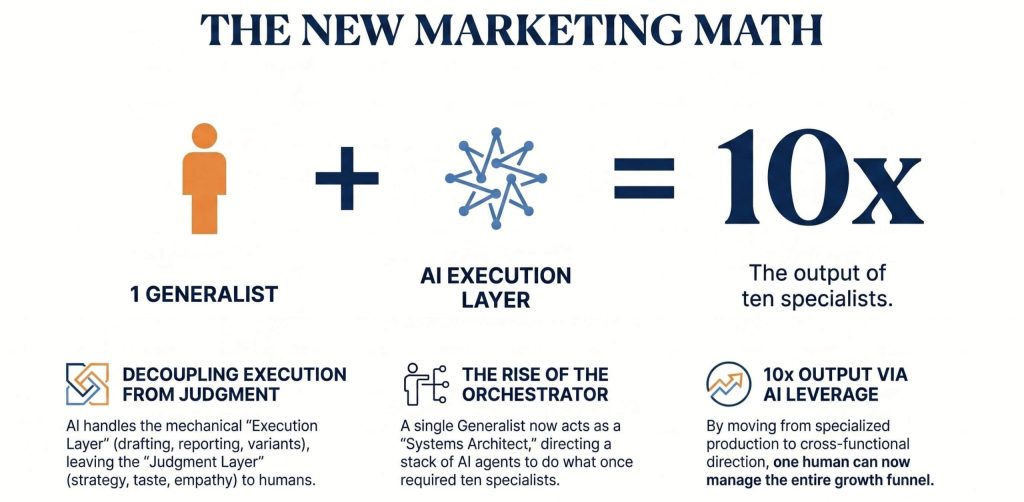
That advice has aged badly. What AI has done to the marketing execution layer has flipped the generalist from “person who hasn’t specialized yet” to “person who can do what ten specialists used to do.” If you’ve been a generalist and you’ve been unsure whether to finally pick a lane, you should not. Your moment just arrived.
This piece is about what’s changed, why the generalist is suddenly the most valuable seat on a small growth team, and what to actually do if you’re one of them.
Why generalists got a bad rap
First, honestly, why was the generalist undervalued for so long? There are a few reasons, and they are all structural.
1. Specialization was expensive to acquire, so it was expensive to buy.
Learning SEO to an expert level took years. Learning performance marketing to an expert level took years. A good specialist had accumulated thousands of hours of pattern recognition you couldn’t shortcut. Companies paid for that depth because they had to.
2. Execution was the bottleneck.
In a world where someone had to actually write the 30 ad variants, someone had to actually set up the email automation, someone had to actually do the keyword research, depth of execution mattered. A specialist could go faster and better than a generalist within their lane.
3. Hiring was easier with clean labels.
“We need an SEO person” is easier to scope, hire, and manage than “we need someone who thinks across the whole funnel.” Management wanted labels. Generalists defied labels.
4. Generalists often lacked taste at depth.
The stereotype wasn’t fully wrong. Some generalists were shallow everywhere. They could set up a Meta campaign but not run one well. They could write a blog post but not one that ranked or converted. The good generalists were rare.
All of this was true. And all of it has quietly stopped being true.
What AI actually changed
Here’s the quietly seismic shift: expert-level execution is now available at the cost of a good prompt.
You want a ranked-quality SEO brief? There are models that produce them in 30 seconds. You want 30 ad variants optimized against a specific angle? Done in two minutes. You want a lifecycle email sequence written to a specific ICP? Another two minutes. You want a landing page draft, a sales deck, a positioning exploration, a customer persona, a research summary? Minutes, not days.
This has two consequences almost nobody has fully internalized yet.
First, depth is no longer the scarce resource. You don’t need a human who spent ten years mastering SEO to get SEO-quality output. You need someone who can direct an AI to produce it and recognize whether the output is any good. The ten-year SEO specialist is still valuable, but they’re valuable for their judgment, not their production capacity.
Second, breadth is suddenly the scarce resource. The bottleneck has moved upstream. Someone has to decide what the SEO brief should be about, in the context of what the brand is trying to do, given what’s happening in paid, integrated with what lifecycle is sending, and coordinated with what the customer success team is hearing. That’s not a specialist problem. That’s a generalist problem.
The old tradeoff was: depth versus breadth, pick one, specialists win. The new tradeoff is: specialists can access breadth through AI, but they rarely do; generalists can access depth through AI, and they naturally will. Generalists, directed well, eat.
What’s dying for generalists
The parts of the old generalist role that are fading:
1. Being undervalued for lack of depth.
The “you haven’t specialized yet” framing is a relic. If a hiring manager still reads your CV that way, they’re showing you they haven’t caught up to how teams work now. That is useful information, specifically regarding whether you should work with them.
2. Being stuck in execution-heavy roles.
The old generalist path was often: do a bit of everything at a junior level, execute on tasks the specialists pass down. That role still exists, but it’s shrinking. AI eats the execution, and generalists who stay in pure execution mode get eaten with it.
3. Having to choose a lane to get promoted.
The career ladder used to go generalist → specialist → head of specialty → head of marketing. The new ladder goes generalist → senior generalist → Head of Growth. You don’t have to pick a lane anymore. In fact, if you have the ambition, picking one too early is now the riskier move.
4. The “growth hacker” caricature.
For a while, generalists got repackaged as “growth hackers.” They were seen as clever, hustle-y, and tactics-obsessed. That framing is dying and good riddance. The modern generalist isn’t a hacker. They’re an orchestrator of a human + AI system. They are a different animal.
What’s becoming more valuable
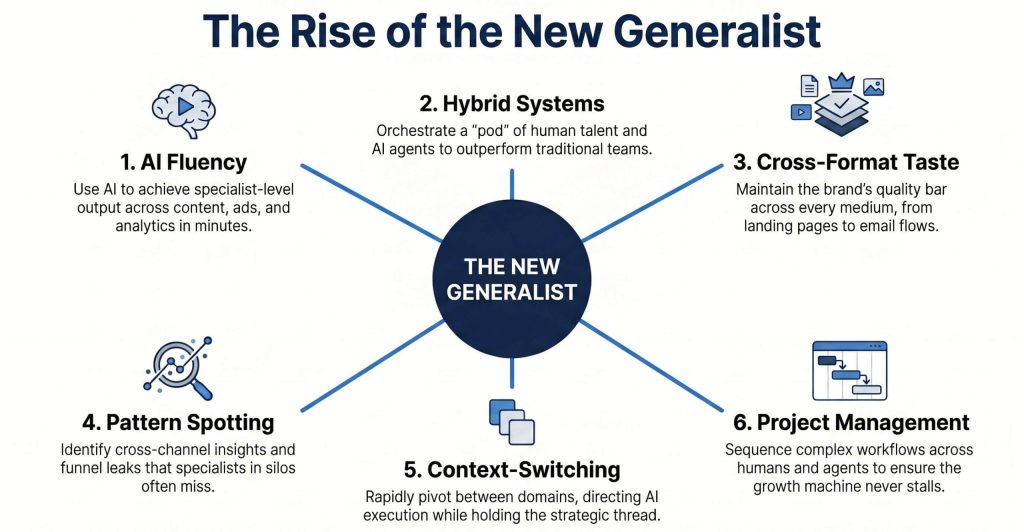
The parts of being a generalist that are genuinely scarce now:
1. Breadth with AI fluency.
Being able to jump from a content brief to a paid campaign to a landing page to a customer email in a single day, directing AI at each step, and producing work that’s good in all four areas. Very few people can do this well. Teams that have one such person punch way above their weight.
2. Coordination across hybrid systems.
Human writers, AI drafters, designers, paid platforms, CRM flows, analytics. Someone has to keep it all moving in the same direction. Generalists are native to this kind of orchestration because they’ve always had to hold multiple things in their head at once.
3. Taste across formats.
A specialist develops taste within their lane. A generalist, specifically a good one, develops taste across the whole surface of marketing. They can look at an ad, an email, a landing page, and a piece of content and tell you which one is pulling its weight and which isn’t. That cross-format taste becomes the quality bar for the team.
4. Pattern recognition across channels.
“The email open rate dropped at the same time the blog post went live” is a connection only someone watching multiple channels will catch. Generalists see patterns specialists miss, because they’re the ones looking at the whole dashboard rather than their slice of it.
5. Context-switching as a feature.
In the old world, context-switching was cited as a weakness. The common critique was that generalists couldn’t focus. In the new world, the job literally is context-switching across domains where AI handles the execution. What was once a weakness is now the shape of the role.
6. Project management, without calling it that.
Most generalists turn out to also be decent project managers, because operating across domains requires it. As AI agents become actual workflow participants, the person who can sequence work across humans and agents is running a project whether they call it that or not.
How to actually become this
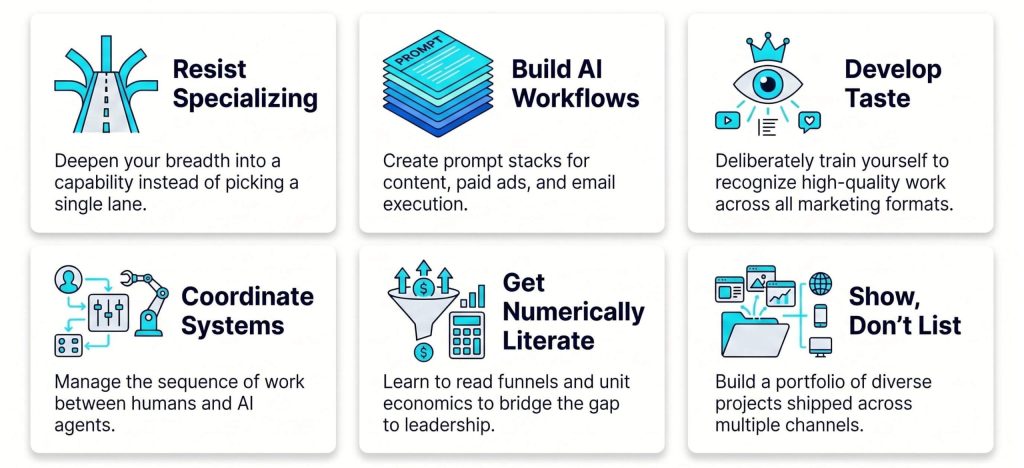
If you’re a generalist, or somewhere on the spectrum, you may want to become the kind of generalist who’s essential rather than interchangeable. Here is what I would focus on.
1. Resist the urge to finally specialize.
If you’ve been told for years you should pick a lane, the instinct now is to pick one and go deep. Don’t. What you want instead is to go deeper on being a generalist — sharpen your breadth into an actual capability rather than letting it drift.
2. Build AI-directed workflows in every area you touch.
Content: build a prompt stack that takes you from topic to brief to draft to polished piece. Paid: build a workflow for creative variant generation and testing. Email: build a system for lifecycle drafts. Analytics: build a reporting workflow that pulls, analyzes, and summarizes. Document what you built. This is the portfolio of a modern generalist.
3. Develop taste deliberately.
Specialists develop taste through reps in one area. Generalists have to develop it more deliberately because their reps are scattered. Read good work in every format. Collect examples of ads that work, emails that convert, landing pages that feel sharp. Write down what makes them good. Taste is trainable if you pay attention.
4. Learn to coordinate hybrid systems.
If you’ve only ever managed your own work, start managing cross-functional work — even informally. Coordinate a launch. Sequence a set of dependent tasks across teams. Learn to see a project not as a to-do list but as a system of moving pieces. This skill translates directly to running a human + AI pod.
5. Get numerically literate.
Not finance-literate at a specialist level, but fluent enough to read a funnel, compare channels, and read unit economics. Generalists who shy away from numbers get capped. Generalists who run toward them become Heads of Growth.
6. Show, don’t list.
A specialist can list their specialty and people roughly know what it means. A generalist can’t rely on labels. You have to show work. Keep a running portfolio of things you’ve shipped across different areas — a blog post, a campaign, a landing page, a customer study, a lifecycle flow. “I shipped these things across these areas” is a stronger signal than any title.
Signals you’re ready
For the modern-generalist version of this role, here’s what I’d look for:
- Can you show me workflows you’ve built that use AI to produce expert-level output in areas you’re not personally a specialist in?
- Have you shipped work across at least four different areas (content, paid, lifecycle, design, CRO, social, support, research) in the last year?
- Can you look at work across formats and tell me what’s good and what’s not — with reasons?
- Can you sequence a multi-stream project without losing the thread?
- Are you comfortable being “the glue” rather than “the star” of a project?
- Have you found something by connecting signals across different channels that a specialist would have missed?
If those are yes, you’re a modern generalist. You shouldn’t be specializing. You should be heading toward a Head of Growth seat — or becoming the indispensable number-two on a growth team today.
The reframe
The generalist was always the right shape of marketer for a small team. What has changed is that the small team is now the efficient team. The generalist, who used to be told to grow up and specialize, is now the person everything else assembles around.
If you’ve spent years being quietly unsure whether you should have picked a lane, I hope this reaches you. You didn’t fail to specialize. You kept your flexibility in a market that didn’t yet reward it. That market just arrived.