
In the first piece in this series, I argued that AI hasn’t destroyed marketing jobs. Instead, it has rewritten them by cleanly separating the execution layer (which AI can mostly do now) from the judgment layer (which it can’t). Every role shifts as a consequence.
The role I want to look at first is Head of Growth. Partly because it’s the most senior marketing role on most teams, partly because I’ve spent the last few months thinking hard about what this role actually looks like now as we rebuild our own, and partly because I think it’s the most misunderstood shift of the lot.
Most of the Head of Growth and Head of Marketing job postings I see right now on Bangladeshi and global job boards read like they were written in 2020. “Oversee the marketing team.” “Manage the content calendar.” “Lead digital campaigns across channels.” “Own the marketing budget.” None of these are wrong, exactly. They’re just aiming at the wrong job.
Here’s what I think the role has actually become.
The old job
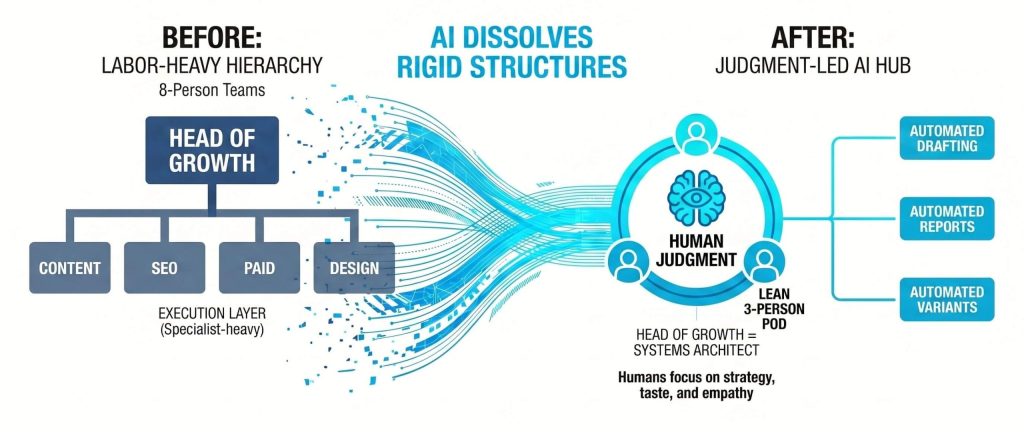
For most of the last decade, a Head of Growth (or Head of Marketing, same genus different species) was essentially a specialist team manager. You sat on top of a group of people, including the content marketer, SEO specialist, paid marketer, designer, social media manager, and performance analyst. Your job was to ensure they pulled in the same direction, hit their targets, and cohered into a funnel.
You ran weekly syncs. You reviewed campaign briefs. You presented results to the CEO every month. You signed off on the content calendar. You approved budget reallocations between channels. You were the interface between marketing and external departments such as product, sales, finance, and founders.
The skill set behind this was real: project management, stakeholder management, channel knowledge broad enough to oversee specialists, enough analytical sense to spot when something was working. It’s what nearly all the “How to become a Head of Growth” articles on the internet still describe.
The problem is that this job was mostly a function of execution being expensive. You needed a team of eight because eight people’s worth of execution had to happen every month. You needed a manager on top because eight people need managing. Pull the execution cost down by 80% with AI, and the whole structure stops making sense.
What AI actually changed for this role
The single biggest shift: the team under you just got smaller, and the team under you is now half-human, half-agent.
The specialists who used to need their own seats now include roles like the content writer, ad copy person, reporting analyst, and social scheduler. These roles have collapsed into AI workflows that a smaller human team directs. Two or three sharp humans with a good AI stack can now do what used to require a team of eight.
This breaks the old Head of Growth role in two ways at once.
First, you’re not primarily a manager anymore. You’re an architect. The system you’re running is a hybrid of humans, AI agents, and automations. You have to design how the pieces fit together, specifically who does what, where the quality gates are, what gets outsourced, and what gets killed. This is a different cognitive job. It’s closer to building a product than running a team.
Second, your personal leverage just went up massively. Where a Head of Growth used to produce most of their output through other people, a modern one can produce enormous output directly. This is because AI has become a force multiplier for exactly the kind of work this role does best, such as strategy docs, customer research syntheses, experiment designs, positioning explorations, and first drafts of everything. The top person on a growth team is now doing more hands-on work than they used to, not less.
What’s dying
The parts of the role that are fading fastest:
Running campaigns. The “I ran 47 campaigns this quarter” resume is a liability now rather than an asset. This is because campaigns are execution. If your proudest work is campaigns rather than decisions, you’re pitching for a job that no longer exists at the top of a growth org.
Managing large specialist teams. If your pitch is “I can manage a team of 10 marketers,” you’re pitching for an era that’s ending. Teams are getting smaller, not bigger.
Activity-based leadership. Presenting slides about how many posts were published, how many emails were sent, how much was spent. This was always a weak version of the role, but AI has made it unambiguously obsolete.
Playbook execution. “I know how to scale a SaaS using the standard PLG playbook.” That playbook is available to everyone now, and most of it is AI-assisted. The generic version of expertise is worth much less than it used to be.
What’s becoming more valuable
The parts of the role that are growing in value, fast:
Systems thinking. Not “strategy” in the vague MBA sense, but concrete design of how the growth machine actually works. What’s the funnel, where are the leaks, what’s the human/AI split at each stage, what are the feedback loops. The Head of Growth is now much more like a systems designer than a marketing manager.
Judgment under uncertainty. AI gives you more options than ever. It provides more variants, more tests, more content, and more channels to try. The scarce skill is knowing what to test, what to kill, and what to double down on. This has always mattered; now it is the whole job.
Customer proximity. AI knows nothing specific about your customers. The Head of Growth who spends three hours a week on customer calls, sitting in on support, reading reviews, will consistently out-market the one who doesn’t. This used to be a nice-to-have. Now it’s the core moat.
Positioning and narrative. What your product is, who it’s for, why it wins. AI can draft copy endlessly, but someone has to decide what the copy is trying to say in the first place. This is judgment work, it compounds, and it cannot be delegated to an agent. In many companies, positioning is where the Head of Growth adds the most leverage.
Financial literacy. CAC, payback, LTV, unit economics, and contribution margin. The modern Head of Growth ties what they do to revenue and runway, not to marketing vanity metrics. If you can’t run a growth model in a spreadsheet, you’re not qualified for this job anymore. This isn’t because of the spreadsheet itself, but because of the thinking it forces.
Team architecture. Designing a small human team with a large AI stack underneath is a new skill. Who to hire, what to outsource, where to deploy agents, what to keep in-house, how to sequence it. People who’ve done this thoughtfully are worth more than people with twice their experience who haven’t.
Taste. Maybe the most underrated one. When your team can produce ten times more content, ten times more creative, ten times more everything, the bottleneck becomes: is any of it good? Someone has to be the final filter, and taste doesn’t come from a prompt.
How to actually become this
If you’re a digital marketer aiming at this role, here’s what I’d focus on — not as a list of certifications, but as a set of moves that will change how you’re perceived by anyone hiring for this job today.
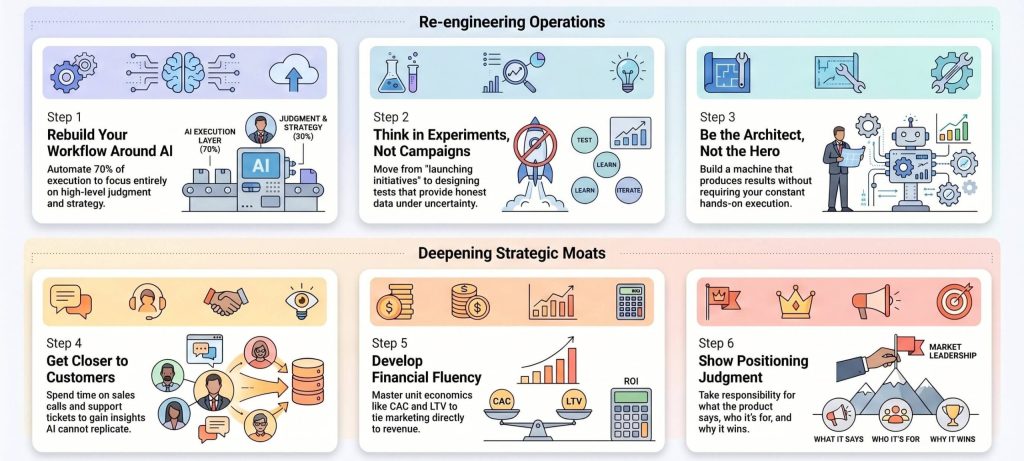
1. Rebuild your own workflow around AI, aggressively.
Not “I use ChatGPT sometimes.” Actually re-engineer how you do your current job so that AI handles 70% of the execution and you’re doing more judgment work. Document what you built. This is the single most credible signal that you understand the shift. If you can’t show this, nothing else on your CV matters as much as you think it does.
2. Get closer to customers than your role technically requires.
Sit in on sales calls. Read support tickets. Message customers directly. Form real opinions about why people buy, what confuses them, what they wish was different. Most marketers don’t do this. The ones who do become candidates for senior roles disproportionately.
3. Develop real financial fluency.
Build a spreadsheet that models your company’s unit economics, including CAC by channel, payback period, contribution margin, and LTV. Do this at the level of someone who makes decisions rather than the level of a finance person. If this sounds like work, it is. It also separates serious candidates from shallow ones faster than almost anything else.
4. Learn to think in experiments, not campaigns.
What’s the hypothesis? What’s the smallest test that would tell us something? What are we going to do differently based on the result? Build the muscle of designing tests, reading results honestly, and killing things that don’t work. This last part is critical. Being able to name something you killed and why is a much stronger signal than being able to name something you launched.
5. Show positioning judgment, not just tactical chops.
Write publicly about a company’s positioning and what you’d change. Rewrite a homepage. Take a stab at a positioning doc. Anyone can run ads. Very few people can sharpen how a product talks about itself. This skill is visible, testable, and hard to fake.
6. Get comfortable being the architect, not the hero.
The modern Head of Growth’s job is to build a machine that produces without their constant hands on it. If you need to be in the execution to feel useful, you’re in the wrong seat. Your value now comes from the decisions, the system, and the quality bar. It does not come from the output.
Signals you’re ready
A rough checklist I apply when I’m evaluating someone for this kind of role:
- Can they talk about funnel math, unit economics, and retention curves without reaching for jargon?
- Can they show me an AI-powered workflow they’ve built or redesigned — specifics, not vibes?
- Have they killed a campaign or initiative they believed in because data said so?
- Have they had customer conversations in the last month that changed their thinking?
- Can they describe a company’s positioning sharply — what it is, what it isn’t, what they’d change?
- Do they think in experiments, or in campaigns?
- Are they comfortable with ambiguity and multi-product chaos?
- Do they have taste — the ability to look at something and know whether it’s any good?
If most of those are yes, they’re a modern Head of Growth candidate. This is true regardless of how many years are on their CV. If most of those are no, they’re pitching for a job that doesn’t really exist anymore.
The quiet good news
Here’s what I find encouraging about all this: the new Head of Growth role is more interesting than the old one. Less meeting management, more system design. Less presenting, more thinking. Less managing specialists, more building with humans and agents that amplify what you can do personally.
It’s also more accessible than it used to be. The people who rise into this role over the next five years won’t mostly be people with twenty years of agency experience. They’ll be sharp, curious operators who understood the shift early and rebuilt how they work. That could be a 3-year-experience marketer as plausibly as a 15-year-one.
If you’ve been wondering whether the top marketing job is still worth aiming at, the answer is yes. However, the version you should be aiming at is different from the one in most job descriptions.