If you are just starting out and wondering where digital marketing can actually take you, here is one of the clearest and best-paying paths in tech: begin as a SaaS marketing intern and grow into a growth leader who owns how a company finds and keeps its customers.
SaaS stands for “software as a service,” which covers products you subscribe to and use online, like a project tool, a design app, or an email platform. What makes SaaS a great training ground is that everything is measurable. Companies track exactly how much it costs to get a customer and how much that customer is worth over time. That means your progress is judged by results you can prove with numbers, not by office politics. If you can bring in profitable customers predictably, you will move up.
This guide walks you through the five stages of that journey, what to focus on at each one, and the signal that tells you it is time for the next step. Save it, and come back to it as you grow.
The career ladder at a glance
Professionals can visualize this career progression as a five-step ladder where each stage builds on previous expertise. They advance steadily through five distinct roles: Intern, Specialist, Senior Lead, Director, and Chief Growth Officer.
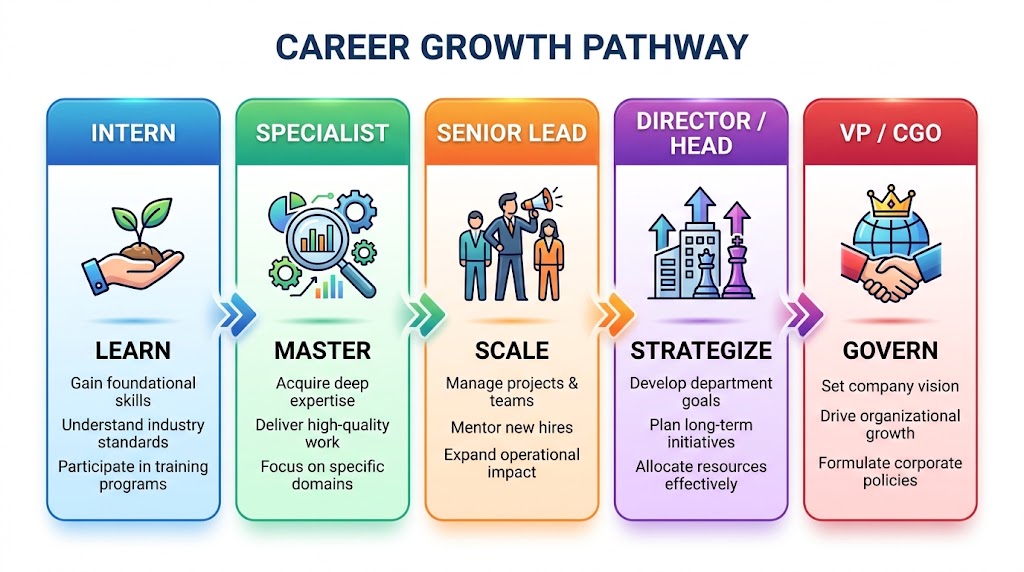
You begin your journey by learning clean execution, and you subsequently master your first marketing channel. You then scale multiple growth channels simultaneously, and you soon manage dedicated teams along with strategic budgets. You finally govern the entire growth engine with executive authority.
Phase 1: Intern / Associate (Months 0–12)
Your goal: build discipline, learn the tools, and make zero careless mistakes.
As an intern you are not setting strategy yet, and that is completely fine. Your job is to keep campaigns healthy and to produce clean, trustworthy data that other people can make decisions with. Do the small things flawlessly and you will stand out fast.
What to focus on:
- Learn the core tools. Get comfortable with analytics platforms (Google Analytics 4, Mixpanel, Amplitude, HubSpot) and ad platforms (LinkedIn Campaign Manager, Meta Ads Manager, Google Ads).
- Get the details right. Write error-free ad copy, prepare clear creative briefs, and manage keyword lists without slips.
- Report what matters. Build a simple weekly dashboard that tracks cost per lead and cost per customer, not vanity numbers like clicks or impressions.
You are ready to move up when you stop just handing over reports and start adding insight. For example, you can explain that cost per customer on LinkedIn went up 18%, but leads from that channel closed at twice the rate, so it is actually your most profitable source.
Phase 2: Channel Specialist / Manager (Years 1–3)
Your goal: own one or two channels completely and drive profitable signups or sales-ready leads.
Marketers take full responsibility for a channel, such as paid search, SEO and content, or a product-led signup loop, including its budget and its results. This role helps you go deep and truly learn how marketing turns into money.
What to focus on:
- Understand the money. Learn how your channel affects the cost to acquire a customer, how long it takes to earn that cost back, and the customer’s lifetime value.
- Test constantly. Keep a running list of experiments, such as A/B testing landing pages, ad hooks, offers, and onboarding steps, so improvement is a habit, not a guess.
- Tie marketing to real pipeline. For business software, focus on sales-qualified leads and pipeline value rather than raw lead counts. For self-serve products, focus on active users and free-to-paid conversion.
You are ready to move up when you hit or beat your quarterly revenue or pipeline target on your channel two quarters in a row.
Phase 3: Senior Lead / Growth Lead (Years 3–5)
Your goal: scale your main channel and open up new ones.
You stop being a one-channel specialist and become an operator who runs a mix of channels. When one source hits a ceiling, you find the next one, and you start improving the whole journey, not just the traffic coming in.
What to focus on:
- Diversify. When paid search plateaus, unlock display ads, affiliate and partner networks, review-site placements (G2, Capterra), or targeted outbound to specific accounts.
- Fix the funnel, not just the top. Work with product and sales to improve signup forms, free-trial flows, and demo bookings, because small conversion gains here compound across every channel.
- Manage outside help. Direct agencies, freelance writers, and video editors so you can produce far more without doing it all yourself.
You’re ready to move up when you take a brand-new, unproven channel from zero to a reliably profitable source of customers.
Phase 4: Director of Performance / Head of Growth (Years 5–8)
Your goal: lead a team, manage the full budget, and align growth with the rest of the company.
At this level you stop running individual campaigns and start managing a portfolio of them. You decide where the money and the people go, and you are measured on company-wide growth.
What to focus on:
- Own the budget. Direct a large annual budget across paid, organic, and product channels to hit the company’s recurring-revenue targets.
- Build the team. Hire, mentor, and set goals for acquisition managers, SEO strategists, lifecycle marketers, and conversion specialists.
- Work across departments. Partner with product on feature adoption, with sales on bigger deals, and with customer success to reduce churn and grow revenue from existing customers.
You are ready to move up when you help grow the business through a major revenue milestone while keeping the cost of acquiring customers healthy, which is typically earned back in under a year.
Phase 5: VP of Growth / Chief Growth Officer (Years 8+)
Your goal: own the entire revenue engine and shape long-term strategy.
This is the top of the ladder. You report growth to the leadership team and investors, decide which markets to enter, set pricing strategy, and are responsible for the full journey, covering a customer’s first impression to how much revenue the company keeps and grows over time.
What you own:
- Present growth, acquisition costs, and expansion plans to the board and investors.
- Decide on new markets, pricing models, and partner ecosystems.
- Own overall efficiency from the first click all the way to long-term customer retention.
The 5 stages side by side
A quick reference for where you are and where you are headed:
| Role | Primary metric | Core tools | Core mindset |
|---|---|---|---|
| Intern | Task completion, clean data | Excel, GA4, ad managers | “Did I set this campaign up accurately?” |
| Specialist | CPL, conversion rate, trial signups | HubSpot, Meta/Google Ads, SEMrush | “How do I lower cost per acquisition on my channel?” |
| Senior Lead | Pipeline generated, CAC payback | Mixpanel, VWO, Zapier, Unbounce | “Which new channel can scale our growth next?” |
| Director | Blended CAC, net-new ARR | Amplitude, Salesforce, Looker | “Where do I deploy budget and people for the best return?” |
| VP / CGO | ARR growth, LTV:CAC, NRR | Enterprise BI, financial models | “How do we win market share and grow company value?” |
Before you apply: the foundation you need
You do not need a marketing degree or paid experience to land an intern role. But hiring managers do expect you to show up with a baseline, which is enough to be useful in week one and to prove you can think in terms of results. Here is what “ready to apply” looks like:
- Understand the marketing funnel. Know how a stranger becomes a lead, and a lead becomes a paying customer through awareness, consideration, and conversion.
- Be comfortable with spreadsheets. Basic formulas, sorting, and simple pivot tables in Excel or Google Sheets. So much of an intern’s work is clean data.
- Read basic analytics. Know the difference between a vanity metric (clicks, likes) and a real one (cost per lead, conversion rate), and roughly how traffic gets tracked.
- Write clearly and without errors. Clean, correct copy is the single most visible skill an intern has. Sloppy writing gets noticed first.
- Grasp SaaS basics. Understand that these are subscription products, and that companies care as much about keeping customers as winning them.
- Have hands-on familiarity with one channel. Even running a small ad, or growing one social or email audience, shows you have actually touched the tools rather than just read about them.
Your starter plan: free resources to get there
Every course below is free to learn, self-paced, and recognized by employers. Work through them in order and you will cover the foundation above in a few focused weeks.
Step 1: Build the fundamentals
- Google Digital Marketing & E-commerce Certificate on Coursera is the most complete beginner path built by Google. It is free to learn, and a certificate fee is optional.
- HubSpot Academy offers a Digital Marketing Certification that is free, widely recognized, and a fast way to learn the funnel and inbound basics.
Step 2: Get certified on the tools
- Google Skillshop offers free official certifications for Google Ads and Google Analytics (GA4). These carry real weight on a resume.
- Meta Blueprint provides free courses on Facebook and Instagram advertising, straight from Meta.
- Semrush Academy features free courses and exams in SEO and content marketing, useful if you lean toward organic growth.
Step 3: Prove it with one small project
Certificates open the door, but a project gets you hired. Run a tiny campaign for a friend’s shop, a local business, or your own page, where you set a small budget, define one goal, and track the numbers. Then write a one-page summary: what you tried, what the data showed, and what you would change. This becomes your portfolio and your best interview story.
Step 4: Apply, and speak the language of results
Target intern and associate roles at SaaS companies because their measurable culture is the fastest place to learn and to prove yourself. Talk in outcomes during every application and interview: cost per lead, conversions, and return on spend instead of “likes” and “reach.” That single shift is what makes a beginner sound like a future growth marketer.
The path from intern to growth leader is not a straight sprint, but it includes five clear stages, each with a skill to master and a signal that says “you’re ready.” Focus on doing today’s stage exceptionally well, keep learning the numbers, and the next rung takes care of itself.