Your main skill is no longer your main value and the data shows why that changes what you need to learn next.
Something strange has happened to most knowledge jobs. The skill that used to define your career is still important. This includes writing clean code, drafting clear reports, building slide decks, running research, and designing interfaces. But it is no longer what makes you valuable.
Five years ago, being good at your core job was a full career plan. In 2026, that sentence sounds incomplete. The thing you are best at, AI is now also good at. Not perfect, but good enough for the first draft, the baseline version, the “acceptable” output. And the first draft used to be your paid hours.
This is the real shift. Your main skill has not disappeared. It has been demoted. It is still needed, but now it is the starting point, not the finish line. What decides your salary in 2026 is what you do on top of that old skill, using AI as the base layer.
The data is quieter than the headlines, and more serious
The news cycle prefers the dramatic version of this story. This includes AI taking jobs, AI replacing humans, and AI ending careers. The actual numbers tell a quieter, more structural story.
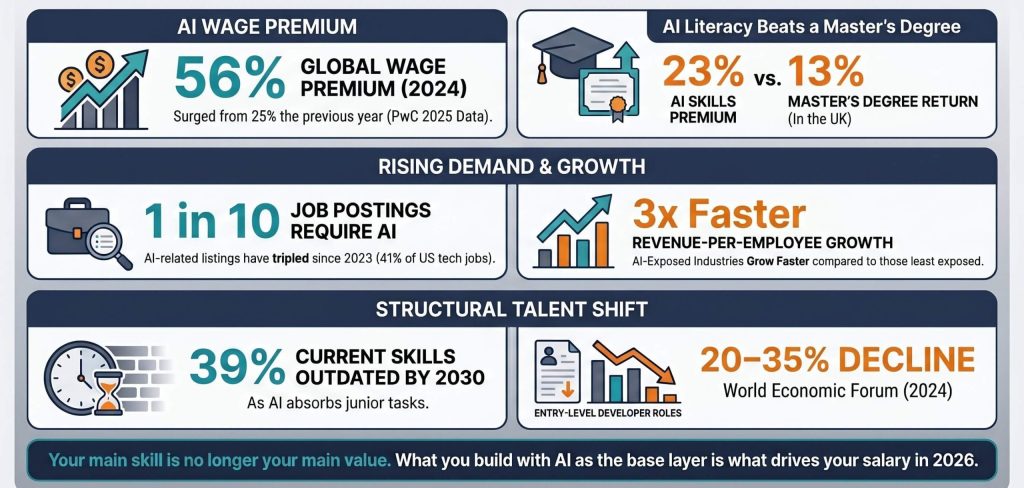
PwC’s 2025 Global AI Jobs Barometer, which analyzed nearly one billion job postings across six continents, found that workers with AI skills earned an average 56% wage premium in 2024. This was more than double the 25% premium just one year earlier. The World Economic Forum’s Future of Jobs Report 2025 estimates that 39% of a typical worker’s current skill set will become outdated or transformed between 2025 and 2030. Lightcast, analyzing 1.3 billion job postings, found that roles explicitly requiring AI skills advertise a 28% salary premium. This is about $18,000 more per year for the same title.
In the United States, 41% of tech job listings now require some level of AI skill. One in ten job postings across all industries explicitly mentions AI. This figure has tripled since 2023. In the United Kingdom, Oxford Internet Institute research showed AI skills command a 23% wage premium. This is higher than the 13% premium for a Master’s degree and the 8% for a Bachelor’s.
Read that last line twice. A short, modular AI course now returns more in the job market than a two-year Master’s program in many fields. This is the category shift, not the headline.
Why the “primary skill” has been demoted
The mechanism is simple once you see it. Most knowledge jobs have two layers.
- Production layer: A production layer is the actual output. Lines of code. Paragraphs of text. Rows of analysis. Images, slides, queries, reports.
- Orchestration layer: An orchestration layer involves deciding what to produce, how to verify it, how to connect it to business outcomes, how to debug failures, how to chain steps together into something reliable.
The production layer is what most professionals were hired for. It is also what AI is now very capable of handling. Claude can write code, draft emails, summarize meetings, analyze spreadsheets, generate designs, review documents. The output is not always perfect, but it is fast, cheap, and close enough that a human then just needs to verify and adjust.
The orchestration layer is where human value now sits. Knowing which task to delegate to AI, how to prompt it reliably, when to trust its output, and how to build systems that combine multiple AI calls into something production-grade is the new primary skill. And very few professionals have it yet.
This is the quiet promotion most workers did not notice happening to them. The job title stayed the same. The job changed.
The definition of “senior” has shifted
Consider what “senior developer” used to mean. Ten years of experience. Deep knowledge of one or two languages. A portfolio of shipped projects. Good judgment on trade-offs.
All of that is still valuable. But today, a senior developer who cannot work fluently with Claude Code, design MCP integrations, build agent workflows, or reason about context management is falling behind a mid-level developer who can. The Dice Tech Salary Report found that professionals working on AI solutions earn 17.7% more than their peers, and this gap is widening. Entry-level developer roles have declined 20–35% globally in the past year as AI absorbs the tasks that used to define junior work.
The same pattern shows up outside engineering. In marketing, sales, HR, and operations, Lightcast found AI literacy alone driving salary uplifts of about 35%. This sometimes happens without any coding involved. A PwC finding worth sitting with: industries most exposed to AI saw revenue per employee grow three times faster than industries least exposed. Companies are not becoming smaller. They are becoming more productive per person, and they are paying the people who make that productivity possible.
What this means for non-native English speakers specifically
There is a reason this shift lands differently for a reader in Dhaka, Lagos, Manila, or Karachi than for one in San Francisco.
For decades, a global tech career came with a hidden tax. You had to sound fluent. You had to attend the right university. You had to match Western time zones. Your credentials carried less weight automatically. This was not because your work was worse, but because the pipeline was built around people who were already inside it.
AI does not remove that tax completely. But it reduces it more than anything else has in a long time. Claude drafts professional English that matches your thinking. It reviews your code. It explains dense documentation in your first language. And this is the part most readers underestimate. The certificates Anthropic issues look exactly the same whether you earn them in Chattogram or California.
There is also a harder side to the same equation. If AI is closing the geographic gap, it is also closing the hiring gap. A junior developer in Dhaka is no longer only competing with other Bangladeshi juniors. They are competing with AI-augmented mid-level developers anywhere in the world who can output three to five times more per day. Oxford research found that AI skills, when supported by a recognized certificate, act as a partial equalizer by offsetting disadvantages of age or education in call-back rates. The certificate matters because it gives the employer something legible to trust.
The comfortable part: the tools are free, structured, and globally accessible for the first time. The uncomfortable part: the readers who move first will take most of the returns.
What “AI skills” actually means in 2026
A common mistake is to believe that using ChatGPT or Claude daily is the same as having AI skills. It is not. Daily usage makes you an AI consumer, not an AI builder. The market pays builders.
Real AI skills today means a specific stack:
- Prompt engineering: writing structured prompts that produce reliable, repeatable outputs
- API integration: calling Claude (or any LLM) programmatically from your own applications
- Tool use and MCP: connecting Claude to external systems, databases, and APIs through the Model Context Protocol
- Claude Code: using AI inside real development workflows, not just as autocomplete
- Agent Skills and sub-agents: designing reusable instructions and delegated sub-tasks
- Context management and reliability: making AI systems predictable at scale
You do not need all six to be employable. You need some of them, proven, with something visible to show.
The cheapest path to catching up: Anthropic’s own learning stack
This is where Claude’s own learning resources become relevant. They are not the only option, but they are the clearest and most credible option right now.
Anthropic Academy launched on March 2, 2026. It offers 13+ structured courses, all free, all self-paced, all with official completion certificates that you can attach to LinkedIn. The most important ones, in order:
- Claude 101 — practical everyday Claude usage
- AI Fluency: Framework & Foundations — strategic thinking about AI collaboration
- Building with the Claude API — the flagship, 8+ hours, from first API call to production architectures
- Claude Code in Action — using Claude inside developer workflows
- Introduction to Model Context Protocol — building MCP servers and clients in Python
- MCP: Advanced Topics — production-grade patterns
- Introduction to Agent Skills — reusable markdown instructions Claude applies automatically
- Subagents — delegated workflows for complex tasks
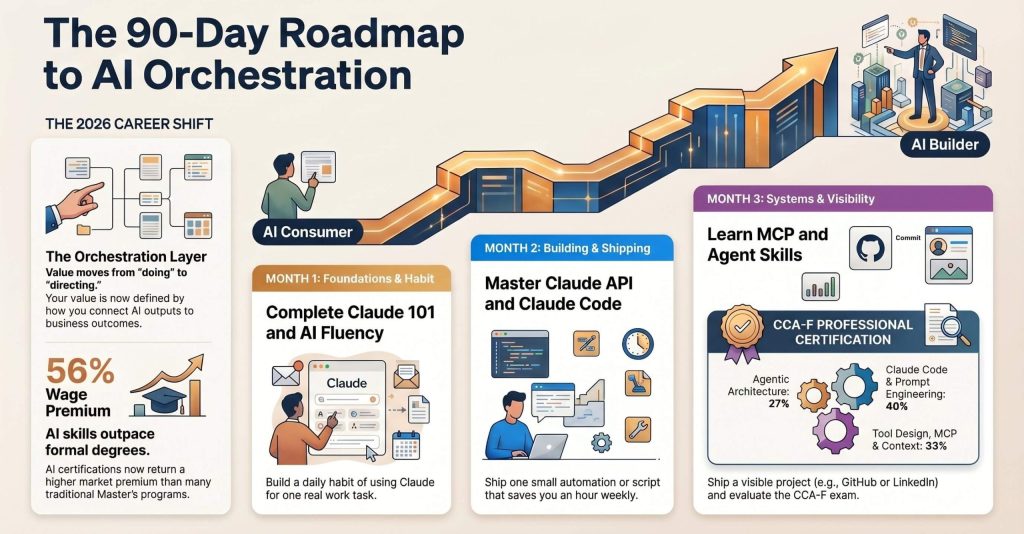
On top of the Academy, Anthropic launched its first formal technical certification on March 12, 2026: the Claude Certified Architect — Foundations (CCA-F). It is a proctored 60-question exam, 120 minutes, closed-book. The domain weights are public: Agentic Architecture (27%), Claude Code (20%), Prompt Engineering (20%), Tool Design and MCP (18%), Context Management (15%). The cost is $99, or free for the first 5,000 employees of Claude Partner Network member companies.
Be honest with yourself about whether the CCA-F fits you right now. It is designed for practitioners already building with Claude professionally. It is not an entry-level badge. For most readers, the right starting point is the free Academy track, and the CCA-F becomes relevant after 90–180 days of consistent building.
A realistic 90-day plan
Plans that promise transformation in 7 days are selling hope. A 90-day commitment is slower, uglier, and actually works.
- Month 1: Complete Claude 101 and AI Fluency: Framework & Foundations. Build a daily habit of using Claude for at least one real work task. It should be a real task, not just a demo.
- Month 2: Complete Building with the Claude API and Claude Code in Action. Ship one small project. This could be a personal automation, a script that saves you an hour per week, or a tool for a colleague.
- Month 3: Complete Introduction to MCP and Agent Skills. Ship one project visible to others, such as a GitHub repo, a LinkedIn post showing the workflow, or a small demo. Then decide whether the CCA-F is worth sitting for.
The LinkedIn post matters more than it sounds. The market in 2026 is not short on people who learned. It is short on people who can show. One visible project a month is worth more than ten completed courses with no public output.
The strategic truth
The old framing of “AI versus humans” was always wrong. The real line is sharper, and quieter:
✗ AI versus humans
✓ AI-capable humans versus humans without AI
The first group will absorb the productivity gains, the salary premiums, the remote opportunities, and the next decade of interesting work. The second group will watch the baseline move away from them one quarter at a time.
The good news is that the border between these two groups is thinner than it has ever been. You do not need to be in San Francisco. You do not need a Master’s degree. You do not need a perfect accent. You need an email address, 90 days, and the willingness to build something small and visible.
Your main skill is no longer your main value. What you build with it is.